
Using Language, Stories and Identity to Move People To Action
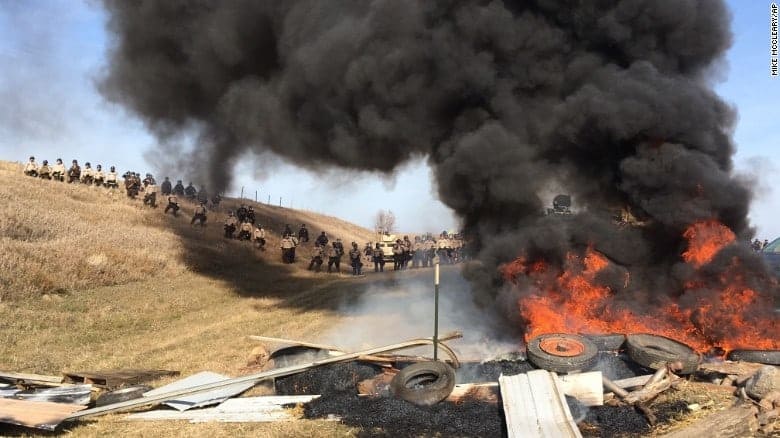
Black smoke. Armored vehicles. Pepper spray. Three hundred helmeted police in black riot gear. Lockstep marching, relentlessly forward. Helicopters. Nightsticks. Snipers. Bean bags. Rubber bullets. Sound cannons. Cell phone jamming.
Waiting.
Drums. Sage. Prayer circles. Tobacco. Song. Unarmed peaceful protestors. Tribal elders. Blockade. A thousand miles of yellow grass to the horizon.
This was the effort to stop the Dakota Access Pipeline from being built and crossing tribal burial grounds. It risked polluting the drinking water for 17 million people and putting gigatons more carbon into our atmosphere and rapidly warming our climate.
In one way, my journey and this book began that day: October 26, 2016, at Standing Rock, North Dakota. I was sitting in the road alongside a Lakota man facing military and police troops. Expecting to get maced or worse, I was frightened and kept reciting the names of my grandchildren as a sort of calming mantra. I didn’t want to be arrested or beaten, but the alternative, a pipeline with the daily carbon emissions of forty coal plants, seemed worse. Violence and chaos were in front of me. I remember the last thing this Lakota man said to me before I was dragged away and arrested. “Look,” he said. “They are the ones who are frightened. We are going to succeed.”
This seemed unlikely to me at the time, and it took me a while to understand what he was saying.
The Standing Rock effort failed, or so it appeared. One hundred twenty-seven water protectors were jailed that day. I was one. The pipeline would go on to be built, and it is now spewing tons of pollution into the air every day. The result is depressing.
Yet, at the same time the effort was a success. The action attracted 12,000 people to a remote stretch of prairie along the Cannon Ball and Missouri Rivers of North Dakota. People came from across the country and world, and for the first time over 200 tribes assembled or lent their support. Peacefully assembling to call out the social injustice of water pollution and pollution of the Earth. It is a case study in non-violent civil disobedience, and it motivated hundreds of thousands of others across racial, geographic, and generational lines, much like the marches of Greta Thunberg, the young Swedish leader. The No Dakota Access Pipeline movement—NoDAPL—changed me and set me on a new path.
The question I asked myself was: How did we get into a situation where 300 stormtroopers are challenging peaceful protectors, when there is a moral imperative to stop burning fossil fuels that risk having a livable planet and a secure future for our kids and families?
I had asked a similar question of myself when I was walking out of a climate talk I had given a few months earlier. The audience was polite, but their applause was tepid. The talk was short and I’m an experienced speaker, but there were few questions, and I wasn’t convinced that the audience was likely to act or call for change. In my talk, I had outlined the basic facts of climate science, the terrible impacts we face, and some potential solutions. I rationalized that the talk was in conservative northern Georgia, but the lukewarm response nagged at me.
I needed to find a better way to communicate—and resolved I would. After forty years as a scientist and professional marketer, I was reminded that when something doesn’t work, you change it. I had to change my assumptions and my approach. The answer was in how we communicate.
So, I began a journey. This book is about what I learned along the way from Standing Rock to my own talk, and what you can learn as well—if you want to change the future. And we must.
I learned that I wasn’t the only one to fail. Others had the same communication problems, and these problems were repeated over and over, all across the country.
The climate movement is failing, and it’s been failing for over thirty years.
The climate movement is failing, and it’s been failing for over thirty years. Specifically, we have failed at mobilizing collective government action on dozens of fronts to stem the rise of global temperature. The consequences of this are getting more serious every day and every year. The confrontation at Standing Rock is just one result. Of course, we have made some progress, but it’s now apparent that we are not making progress fast enough.
The messaging and communications of the climate movement are not working well enough to get people to act.
Americans are facing a hurricane of destructive propaganda and disinformation from the fossil fuel industry and its political allies. They do a better job of strategizing, communicating, and creating frames that are easy for the public to understand. They are better at funding and coordinating their messages. Next, our media compounds the problem by creating the false equivalency of balancing two sides of what is in fact a very unequal argument, and by using fear and catastrophe to capture attention and ratings. Moreover, they fail to cover the progress we are making as well. And finally, the messaging and communications of individuals and organizations promoting action on the climate are not working well enough to get people to act. This book focuses primarily on the latter, and how we can shift our narratives, stories, and frames towards shared values that motivate people to act.
The climate movement has a science problem.
The climate movement has a science problem. Not the science of our atmosphere or the science of technical solutions, but the science of human psychology and communications. It turns out that we have just as many science deniers in the climate movement as climate deniers in our society. This denial is not intentionally false and comes from lack of knowledge. Yet, if we get psychology wrong, then we’ll likely get the messaging and communications wrong, too. The result will be inaction and failure.
What if we could get people to act on the climate crisis? The past year, 2024, was the hottest year in recorded modern history.[i] In 2020, forest fires—58,000 of them—burned over 10 million acres, a rate that would equal the state of Ohio in four years.[ii] Droughts and floods due to extreme weather caused by climate change whipsaw through our farmlands and communities. Last year the United States faced over $93 billion in climate-related damages.[iii] Global overheating is the biggest threat we face for ourselves, our families and our communities. But merely relaying this information doesn’t get people to act.
Better communication acts like an accelerator for climate action, just like a few Standing Rock elders were able to have the world begin to take notice and support their nonviolent cause. While not acting directly on the challenge, every action and every solution starts with how we think about it, how we communicate, and how we motivate others.
Cognitive scientists have made real progress in understanding what works and what doesn’t when it comes to motivating behavior. But there is a gap between what they understand and what climate activists implement in their everyday communications. This book is focused on bridging that gap so we can assure ourselves and our children, a just and survivable life on a livable planet.
At first, my search focused on finding a few magic words that would persuade people to act. To my disappointment, I found that while words are indeed magic, there are no magic words. Some words and frames are more effective than others, and we’ll cover those. However, there are also effective communication strategies and tactics for getting people to act. They are quite simple and can be adapted by both individuals and organizations.
Almost every climate communication can be made better.
I found that almost every climate communication can be made better. We must stop doing things that don’t work and avoid the traps and barriers that hinder effective communications. To do this, we need to understand these barriers, the way humans think, and our human biases.
Next, we must understand what works and why. Put simply, people need to be attracted and connected by what they already believe rather than be persuaded or convinced by what they don’t yet believe. We must also understand our political identities.
My friend and political analyst, Antonia Scatton says it this way: “While not all climate communication is political, cognitive science tells us that people make political decisions based on a larger understanding of what is right and wrong that lies at the core of their identity.”
Creating good climate communications requires us to help others see the world as we see the world and to realize that they are already just like us. They are good people who think they are doing the right thing for their families, communities, and our country, which solidifies their shared identity with us.
Lastly, we need to be able to tell better stories that evoke the values and emotions inherent in helping people see what’s right. Because stories are more effective than facts or reasons at reaching people and getting them to act.
* * *
This book is for two audiences. The first audience is all of us who are climate activists and want to be more effective at getting others to act, whether this means demanding political action, working on projects, or making personal changes. The book is designed to help you move those who are concerned, but are not yet acting, and those who are cautious but are not yet engaged on the climate crisis. My promise to you is that your communications will soar if you pick up even just one or two techniques. The second audience is directors and communication managers of environmental, clean-energy, and climate organizations. Your reach and impact are greater than that of any individual. As a result, you can do both more damage and more good depending on your communications approach.
There is a gap between academia and the application of climate communications research. Much of it is based on the work of cognitive and social scientists. But this book is really constructed around strategies, stories, essays, and thoughts that I hope you find useful. You will find light endnotes for reference.
My last decision involved politics. Should this be a book about the political aspects of climate or not? What if I offended people on the other side?
The issue of climate is now more polarizing than gun control or abortion.
In the United States, the issue of climate is now more polarizing than gun control or abortion. Climate shouldn’t be a political issue at all, but it is, and therefore it’s a matter of identity. So I decided to include the political aspect of communicating about climate because otherwise we’d be ignoring the elephant in the room (pun intended). The United States has one of the only political parties in the world that denies the climate crisis. Climate denial is now the official policy of the United States. This doesn’t mean that there aren’t conservatives who want to act on climate. But we will not succeed by having one party triumph over the other.
Yet this is not a both sides book. There is no moral equivalency between working to slow climate change and the extreme MAGA Republican position of denying climate change and promoting fossil fuels. This book’s main audience is liberals. The left wastes a lot of anger and energy ridiculing the right. That doesn’t help, and it often just amplifies the right wing’s narratives and frames. Our communications have to exist in a politicized world of dominant but bankrupt narratives. Our job is to reclaim the climate narrative.
Our job is to reclaim the climate narrative.
* * *
No introduction is complete without a few caveats.
One of the problems of communicating about climate is addressing which climate we are talking about. Climate is an intellectual word that represents a large array of concepts, issues, and solutions. It is global, it is scary, and it is hard to get our heads around the scope and urgency. These qualities make it difficult to talk about. From a communications standpoint, the answer is that we need to talk about both the large-scale climate problem and also the components that make it up, as well as their solutions.
If we talk about climate, people’s attention almost always gravitates toward the largest problem—global climate change. But none of us, acting alone, can keep the polar ice caps from melting, so our individual actions must be focused on thousands of smaller challenges. Good communications are also required for these too. Unless otherwise noted, the word climate will refer to the larger issue of global climate change.
Finally, some points are repeated—for example, the description of frames. This is intentional and allows the reader to start anywhere or flip to any section. Please forgive me for a few repetitions.
I also want readers to know that I have intentionally not used artificial intelligence (AI) to write any of the content of this book or to edit it. I feel that AI is a carbon bomb, and its use should be limited as it also stifles critical thinking. That said, I tried it briefly to help ease the drudgery of formatting my endnotes. It helped some, but required corrections for inaccuracies.
* * *
Recently, I gave a new presentation to a master gardeners group in Georgia. The request started with a phone call from their event coordinator. She told me that she read my Substack and thought that I should talk to her group about climate. I asked her, “What’s the political demographic of the group?”
She said, “Ohhhhhh,” and then trailed off. “I’m the only liberal, and they don’t like me a lot.”
If I took this engagement, I realized, I wouldn’t be preaching to my own choir anymore. I had to change my assumptions and my approach. My own misgivings suggested that I shouldn’t accept her invitation. One of the basic principles of good communication is being the right messenger. I’m a Yankee with a Minnesota accent, I’m not a gardener, and I’m not politically conservative. I would be unlikely to kick ass with this group, and given how politically polarized the climate crisis is, the crowd would be likely to kick mine.
I accepted anyway, knowing that to succeed, I’d need to throw out most of what I thought I knew.
In my talk to these twenty-five gardeners, I found something of mutual interest, and I didn’t mention the words climate change once. I did mention the impact of overheating due to pollution. At the end of the talk, four people came up to me to ask what they could do to help (the climate). As you read this book, you will have to throw out your assumptions and begin to understand how our brains work and how we can use this knowledge to be more effective communicators. Ironically, this a rational, logical, and fact-based approach to giving up your adherence to reason and facts.
What I did do in this talk was share my values, my appreciation for nature, and the changes I have seen. I told a few good stories. But I also tried to paint a picture of potential and hope. The same hope that the Lakota man had given me. A vision for the future. One where we breathe clean air, drink pure water, and have a safe secure world for all of us. It was a small step, but a step forward, nonetheless.
Altogether, I hope this book provides you the why, the what, and the how of better communications for climate, and together we can create that world. It will be difficult, but I am reminded of a line from a Wallace Steven poem: “After the final no there comes a yes, and on that yes the future world depends.”
I believe this is the lesson that the Lakota man sitting next to me in the road at Standing Rock was saying. With potential and vision, we can succeed.
We are all connected. Savor the Earth!’™
– Hobie,
RETURN HERE NOW TO SECURE YOUR COPY
[i] National Centers for Environmental Information, “2023 was the warmest year in the modern temperature record,” National Oceanic and Atmospheric Administration (NOAA), January 7, 2024, www.climate.gov/news-features/featured-images/2023-was-warmest-year-modern-temperature-record.
[ii] National Centers for Environmental Information, “Annual 2023 Wildfires Report,” NOAA, January 2024, www.ncei.noaa.gov/access/monitoring/monthly-report/fire/202313.
[iii] Adam B. Smith, “2023: A historic year of U.S. billion-dollar weather and climate disasters,” National Centers for Environmental Information, NOAA, January 8, 2024, www.climate.gov/news-features/blogs/beyond-data/2023-historic-year-us-billion-dollar-weather-and-climate-disasters.


Leave A Comment